
The Waeyo Platform
The validation layer between your sales strategy and your shop floor.
Waeyo continuously validates whether the sales behaviours your HQ defines are executed in real customer interactions — and shows every store the one behaviour change that matters most.
A behaviour execution profile
| Behaviour | Hero benchmark | Individual staff |
|---|---|---|
| Opening / Approach | 84% | 74% |
| Need Discovery | 78% | 52% |
| Product Knowledge | 86% | 68% |
| Clear Recommendation | 76% | 47% |
| Next-Step Prompt | 70% | 38% |
| Accessory Add-On | 72% | 34% |
| Bundle Selling | 68% | 31% |
| Upgrade Framing | 71% | 44% |
| Service Attachment | 74% | 58% |
| Value Framing | 80% | 62% |
| Campaign Product | 82% | 55% |
| Promo Discipline | 77% | 40% |
What the platform does.
Strategy, validated against reality.
Execution validation
Continuously compare the behaviours you train, brief and expect against what happens in real customer interactions — not a quarterly snapshot.
Your winning playbook, written by your own stores.
Most Valuable Behaviours
Identify and quantify the behaviours that separate your strongest stores from the rest of the network.
Compare stores against your best — not an industry average.
Stronger-store benchmarks
Every benchmark comes from stores that share your products, pricing and brand.
One view across every store.
Network-wide execution visibility
Store execution patterns rolled up by store, region and network, so leadership sees where execution is strong and where it drifts.
One priority per store.
Behaviour improvement focus
Instead of a long audit report, each store receives a single focused behaviour priority — the change most likely to move its conversion.
Not promised. Demonstrated.
Proof of improvement
Re-validation over time shows whether behaviour actually changed after training, coaching or a new campaign.
You can already measure the result. Waeyo measures the behaviour.
The tools most retail networks already run are built to measure outcomes or compliance — not everyday selling behaviour.
POS data
Tells you what a store sold, not how it sold.
POS reporting shows conversion, transaction value and units after the fact. It cannot show whether staff discovered the customer's need, recommended clearly or offered the add-on — the behaviours that produced or lost the sale.
Mystery shopping
Samples a single visit a few times a year.
A scripted visit two or three times a year is a snapshot of one conversation on one day. Results arrive weeks later and say little about the thousands of interactions in between.
Store visits
Capture behaviour only while a manager is watching.
Execution changes the moment a regional manager walks in. Scheduled visits validate presentation and compliance — not how staff actually sell on an ordinary afternoon.
The behaviours that decide conversion happen in thousands of everyday customer conversations — and until now, they have been invisible to HQ.
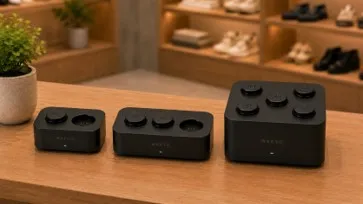

The Waeyo Box
Plug it in. It works.
Waeyo runs on a discreet device that sits in your store — no fit-out, no wiring project, no new screens on the shop floor. It works out of the box, so a pilot store can be live the same day it unpacks it.
No complicated store setup
No store fit-out, no IT project and no integration work to get started. Place the box, plug in power, and it starts validating.
No staff re-training
Staff keep selling the way they always have. There is no app to learn, no check-in routine and no change to the customer conversation.
Plug and play, out of the box
Each box arrives pre-configured for your deployment, and store-level results appear in your Waeyo dashboard.
Your playbooks. Your training. Your standards.
Waeyo does not replace your sales methodology — it validates it. Deployments are configured from the playbooks, training programmes and campaign briefs your HQ already produces.
Store-level insight — with or without individual scoring.
Waeyo is designed for sales behaviour validation. Only aggregated commercial signals are analyzed — no recordings, no transcripts — and the default configuration focuses on staff-side interaction patterns. It is not intended for individual staff surveillance.
Privacy by design →